
What’s Really Changing in the Way Children Learn?
- School Leaders, Teaching
- April 17, 2026
- Saloni Sacheti
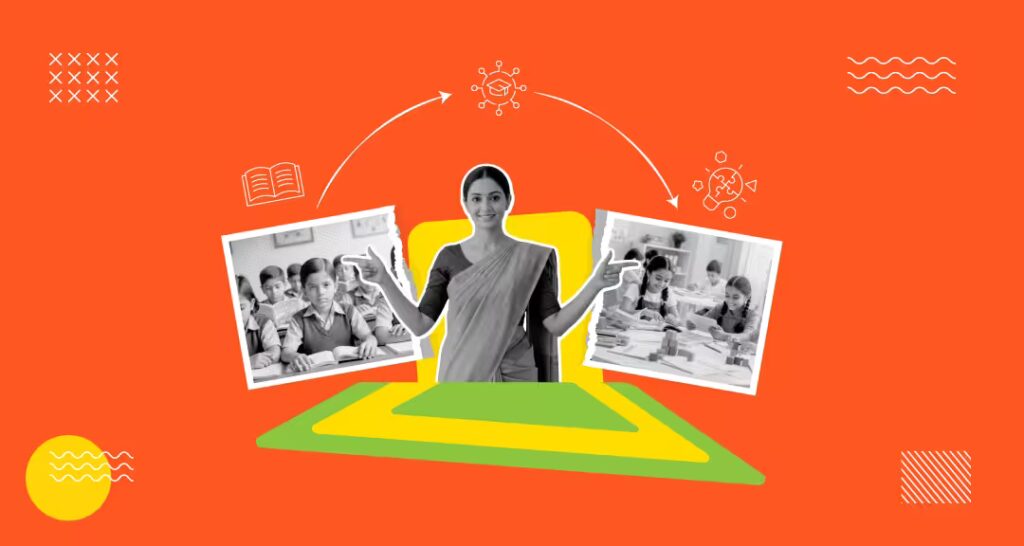
CBSE New Curriculum Updates 2026–27
What if your child could learn at their own pace?
What if learning a language meant connecting with culture, not just passing exams?
What if concepts like Artificial Intelligence started as early as primary school?
That’s exactly the direction CBSE 2026–27 is moving towards.
What may look like a set of curriculum changes on paper is actually a deeper shift in how classrooms will function—how students will learn, and how teachers will teach.
Here are the three biggest changes coming to CBSE classrooms and why each matters for students, parents, and teachers.
Update 1: The Three-Language Formula
The new three-language structure—R1, R2, and R3—builds on a familiar system, but adds more nuance. It defines clear proficiency levels for each language, not just adding another subject.
R1 is where a child should be most comfortable, usually the mother tongue or regional language.
R2 adds communication skills.
R3 begins in Class 6 and emphasises practical knowledge over mastery.
This framework highlights Indian languages, culture, and knowledge systems. Language serves as a link to students’ roots, not just as a communication tool.
Assessment shifts as well. Instead of a high-stakes board exam, the third language (R3) is evaluated at the school level in Class 10. This lowers pressure while maintaining meaningful learning.
Why this matters
The three-language formula is designed to boost multilingualism, cognitive skills, and inclusion of regional languages.
Where the concerns lie
Despite good intentions, this change raises concerns. Parents worry about increased academic pressure, especially in middle school. Schools struggle to find enough qualified language teachers.
Implementation is another concern. Well-designed though it is, schools need guidance on how to fit these changes into their current schedules and infrastructure.
Update 2: Dual-Level Maths and Science
One of the more progressive changes is the introduction of dual-level learning in Maths and Science for Classes 9 and 10. CBSE now offers two learning pathways: standard, for foundational knowledge, and advanced, for deeper study. This move breaks from the old “one paper for all” model. It recognises that students learn at different paces and have different strengths.
Why this matters
Dual-level Maths and Science let students progress at a pace and depth that better fits their individual skills.
At the same time, students inclined towards STEM fields have the opportunity to challenge themselves early on.
Where the concerns lie
Choice can be confusing. Parents wonder whether the standard level closes doors and worry that students may feel labelled for their choice.
Schools must now rethink teaching methods. Differentiated instruction requires planning, training, and resources that many schools do not have today.
Update 3: AI and Computational Thinking from Class 3
Perhaps the most talked-about change is the introduction of Artificial Intelligence (AI) and Computational Thinking (CT) from as early as Class 3. CBSE is not introducing heavy coding at this stage. The focus is on logical thinking, pattern spotting, and problem-solving through simple activities.
In the early years, students will not be writing code. They will be learning how to think. As students reach middle school, these foundations lay the groundwork for a more structured study of AI, its uses, and ethical issues.
Why this matters
With AI all around us, early introduction ensures students become informed, active participants in today’s digital world.
Teaching AI and CT early equips students with 21st-century thinking skills crucial for future challenges.
Where the concerns lie
Many schools lack teachers trained in AI or computational thinking. Parents often confuse AI with coding and want more clarity.
CBSE plans to introduce AI and CT through activity-based learning, ensuring accessibility and engagement for young children without causing overload.
The Bigger Picture: A Shift in Philosophy
All these changes show CBSE is shifting from a rigid, exam-focused system to a flexible, learner-centred one.
Languages are being taught for connection, not just marks. Subjects like Maths are being adapted to individual ability levels. And futuristic skills like AI are being introduced in an age-appropriate manner.
Policy is just the first step. Real impact depends on effective implementation.
For schools, this is a transition. For teachers, a chance to upskill. For parents, it’s time to understand that learning now differs greatly from a decade ago.
Frequently Asked Questions (FAQs)
1. Will the three-language formula increase my child’s workload?
It may feel like an addition, but CBSE has balanced this by reducing the assessment load for R3 and focusing on proficiency rather than depth.
2. Is English being removed?
No, English remains part of the system, though its category may vary.
3. Should my child opt for advanced Maths or Science?
This depends on interest and comfort level. The standard level is designed for general learning, while the advanced level is for deeper exploration.
4. Is AI too early for young children?
The curriculum is designed to be age-appropriate and focuses on thinking skills rather than technical complexity.
Share On:
Written By:


AI is not essential, but it works best as a support tool.
For young children:
70–80% learning should be through teachers, books, and activities
20–30% can be through AI or digital tools
Insightful breakdown.
Very useful information.
Thank you, Archita! We are glad to hear you found it useful.
Very useful information
Thank you for the feedback, Sunaina; we are glad you found this information useful.