

Continuous professional development is no longer an add-on — it is essential for ensuring high-quality teaching and meaningful learning outcomes.
OECD’s TALIS study repeatedly shows that professional development is the single strongest school-based predictor of student success. UNESCO’s Global Education Monitoring Report adds that schools that invest consistently in teacher learning see better attendance, higher retention, and more sustained academic growth.
The National Education Policy (NEP 2020) mandates 50 hours of annual CPD, reflecting global standards. But the spirit behind this requirement goes deeper:
“A continuously learning teacher creates continuously learning students.”
For school leaders, the question is no longer “Should we invest in teacher training?”
It is:
“How do we build a culture where teacher learning becomes a natural, ongoing, and measurable part of our school’s ecosystem?”
This blog gives school owners and principals a research-backed, practical blueprint.
Why Continuous Learning Matters for Teachers
Today’s classrooms are profoundly different from what they were 5–10 years ago. Teachers must navigate:
- Multilevel, mixed-ability classrooms
- New assessment frameworks
- Technology-enabled learning (LMS, AI, e-content)
- Increased parent expectations
- Student mental health and well-being
- Curricular shifts under NEP
- Competency-based education
A static skill set no longer works.
Continuous learning helps teachers:
- Adopt modern pedagogies, like experiential learning, flipped classrooms, inquiry-based learning — all proven to raise engagement.
- Integrate technology meaningfully, not as a replacement, but as an enhancer (AI tools, digital assessments, blended learning).
- Develop social-emotional competence: Critical as schools see rising attention needs, anxiety, and behaviour issues.
- Stay aligned with board and NEP 2020 expectations, which emphasise competency-based education, interdisciplinary learning, skill development, and updated assessment frameworks for all classes.
- Build professional confidence: Teachers who learn continuously feel more empowered, less stressed, and more invested in the school.
When teachers grow, schools strengthen their academic systems and overall functioning.
The Connection Between Teacher Training and Student Success
Research consistently shows a direct correlation between teacher expertise and student achievement.
Key Findings:
- Students taught by trained teachers outperform peers by 20–40% (World Bank, 2021).
- Well-trained teachers foster higher-order skills like reasoning, communication, and problem-solving.
- Behavioural issues decline when teachers use modern classroom management strategies.
- Engagement increases with active learning methods.
Let’s break it down practically:
When a teacher learns a new teaching strategy…

When a teacher learns how to differentiate instruction…

When a teacher is trained in SEL or classroom management…

In short:
Teacher development is not a cost. It is a multiplier of student outcomes.
Building a Culture of Continuous Learning in Schools
Many schools hold workshops — few create true learning cultures.
A learning culture is not a training calendar. It is a mindset that:
- Values improvement over perfection
- Encourages reflection over routine
- Promotes collaboration over isolation
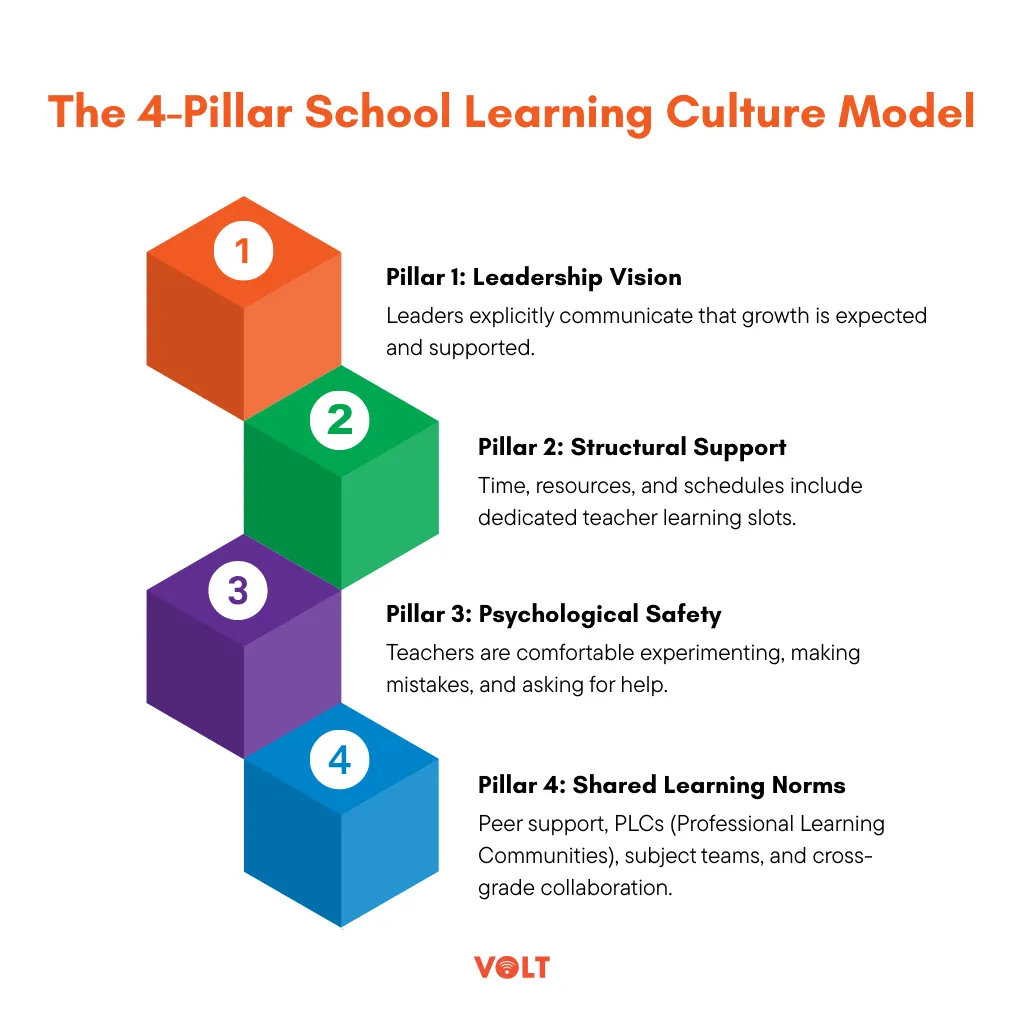
Framework: The 4-Pillar School Learning Culture Model
Pillar 1: Leadership Vision
Leaders explicitly communicate that growth is expected and supported.
Pillar 2: Structural Support
Time, resources, and schedules include dedicated teacher learning slots.
Pillar 3: Psychological Safety
Teachers are comfortable experimenting, making mistakes, and asking for help.
Pillar 4: Shared Learning Norms
Peer support, PLCs (Professional Learning Communities), subject teams, and cross-grade collaboration.
Practical Steps for Principals:
- Set a PD Goal for the year (e.g., “Improve questioning skills across all subjects”).
- Include learning targets in teacher appraisals.
- Establish reading circles, micro-learning sessions, and peer observations.
- Celebrate teachers who apply new strategies — recognition drives culture.
Supporting Teachers Through Structured Training and Workshops
High-quality workshops are one of the most effective ways to strengthen teaching practices across an entire school. But the impact depends entirely on how well these workshops are designed, delivered, and followed up. When schools adopt a structured approach to teacher training, the results are visible not only in the classroom but also in planning, assessment quality, and overall teacher confidence.
Characteristics of high-quality workshops:
- Connected to current challenges (not generic).
- Continuous — not one-off.
- Hands-on, practice-oriented.
- Followed by implementation tasks.
- Supported by leadership.
Why Structured Training Matters
Research consistently shows that teachers develop stronger professional habits when training is:
1. Relevant to current school needs:
Workshops must address real challenges teachers face — such as classroom engagement, managing mixed-ability groups, integrating digital tools, or adapting to competency-based education. Generic sessions rarely bring meaningful change.
2. Continuous rather than one-off
Learning does not happen in isolation. Schools that plan a sequence of workshops over the year—supported by check-ins, classroom observations, and feedback—see significantly better implementation.
3. Practical and hands-on
Teachers benefit most when training includes demonstrations, model lessons, group activities, and real classroom examples. Practical exposure helps teachers immediately apply strategies in their classrooms.
4. Followed by implementation and reflection
Post-workshop tasks, lesson planning exercises, reflection sheets, and peer discussions ensure that learning becomes part of daily practice.
5. Backed by leadership
When school leaders participate in or endorse workshops, teachers feel encouraged to implement new methods with confidence.
Structured, intentional training builds a professional growth pipeline for teachers across all grade levels.
How Structured Training Strengthens Schools
Schools that invest in well-planned workshops experience benefits at multiple levels:
 Teaching consistency across grades Stronger classroom environments Faster onboarding of new teachers Alignment with NEP 2020, board guidelines, and parental expectations Continuous innovation
How VOLT Learning Supports Schools
VOLT delivers practical, research-based training across schools with sessions such as:
- SEL in Schools
- AI in the Teacher’s Toolkit
- NEP Key Pedagogical Issues
- Digital Discipline
- Implementing Competency-based Education
- Assessment Strategy Under the New NCF
These workshops help schools build sustainable teacher growth ecosystems.
Key Components of Effective Teacher Training Programmes
For workshops and training sessions to create lasting change in classrooms, they must be built on strong foundations. Leading frameworks from OECD, UNESCO, and CBSE outline a set of essential elements that every professional development programme should include. These elements help school leaders move from one-time workshops to a systematic approach that drives ongoing teacher growth.
- Needs Analysis: Training must solve real problems (slow learners, low engagement, improper planning).
- Clear, measurable goals: e.g., “Teachers will use three active learning strategies per week.”
- Practical, classroom-ready strategies: Teachers learn best when they can apply things immediately.
- Coaching or follow-up: Check-ins, lesson observations, feedback cycles.
- Reflection: Teacher journals, self-assessment rubrics, post-training assignments.
- Evaluation:
• Did student behaviour change?
• Did lesson delivery improve?
• Did results improve?
Without measurement, training becomes an event — not a transformation.
Measuring and Evaluating the Impact of Professional Development
Investing in teacher training is only the first step — the real value lies in understanding whether that training is actually improving classroom practice and student learning. Many principals ask an important question:
“How do we know if our professional development efforts are working?”
Global best practices recommend using a structured evaluation framework, and one of the most widely adopted models is the Kirkpatrick Model, adapted for educational settings. This model helps schools move beyond certificates and attendance to truly measure change.
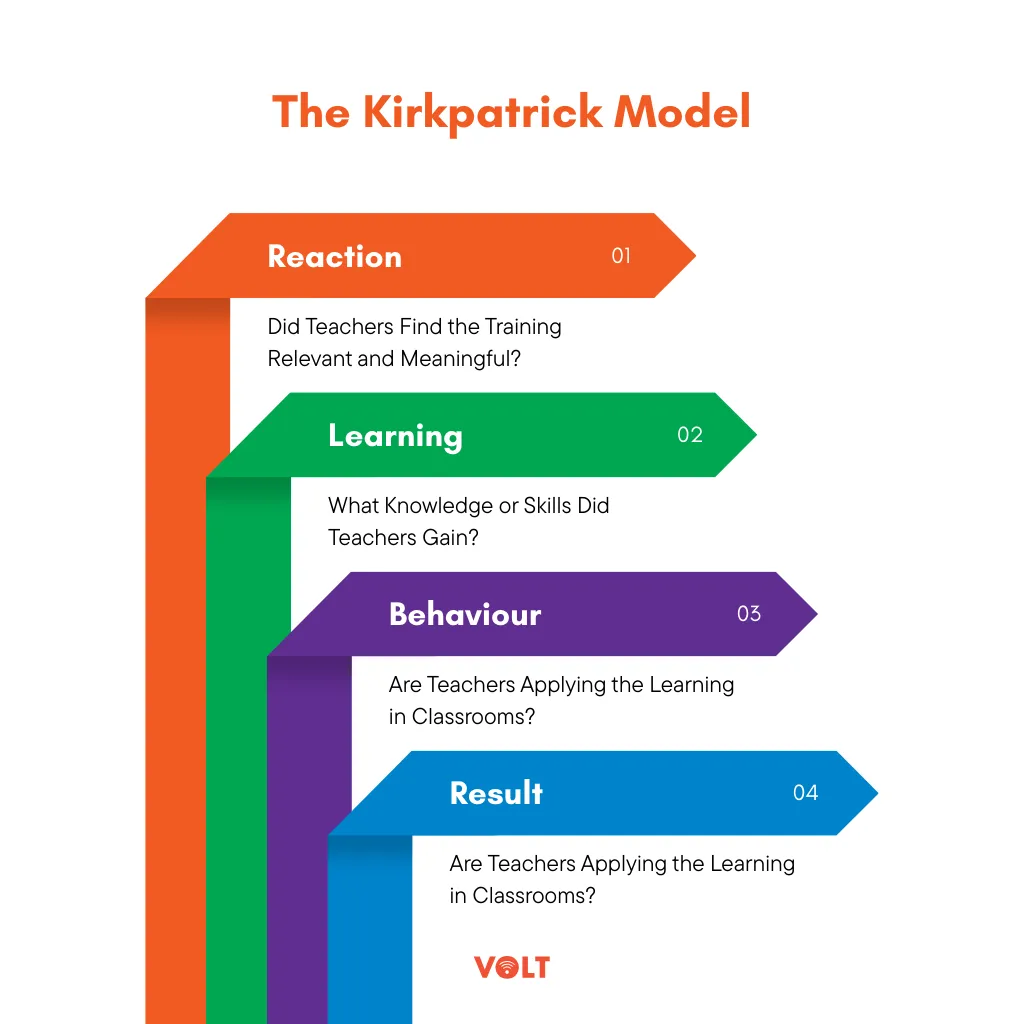
Level 1 — Reaction: Did Teachers Find the Training Relevant and Meaningful?
This level looks at teachers’ immediate feedback.
- Did they feel the session addressed real challenges?
- Were the examples and demonstrations useful?
- Did the workshop feel practical and connected to their classroom realities?
A positive reaction matters because teachers are more likely to apply what they learn when they feel valued and engaged during the session.
Level 2 — Learning: What Knowledge or Skills Did Teachers Gain?
This focuses on what teachers actually learned, not just what was delivered. Schools can assess this through:
- short quizzes
- reflective tasks
- micro-assignments
- lesson redesign activities
This stage helps leaders understand whether teachers have grasped new strategies, frameworks, or tools.
Level 3 — Behaviour: Are Teachers Applying the Learning in Classrooms?
This is the most critical level for implementation. It evaluates whether teachers are actually using the strategies covered in training. Evidence includes:
- classroom observations
- improved lesson plans
- student engagement indicators
- new activities, teaching aids, or assessment methods in use
If behaviour is not changing, it signals the need for coaching, follow-up sessions, or peer support structures.
Level 4 — Results: Is There a Visible Impact on Student Learning and Classroom Environment?
This level measures the broader outcomes of training, such as:
- higher student participation
- improved academic performance
- reduced behavioural issues
- better-quality assessments aligned with competencies
- increased consistency in teaching across grades
This is where training translates into school-wide improvement.
Why Evaluation Matters
Schools that consistently measure professional development see far better results because they can:
- identify which trainings are working
- refine or replace ineffective programmes
- provide targeted coaching based on teacher needs
- build a culture of accountability and growth
Measuring impact ensures that professional development becomes a transformation — not just an event on the calendar.
Five Research-Backed Professional Development Resources for Educators
- CBSE Training Portal – mandatory courses with strong pedagogical value.
- DIKSHA – NEP-aligned teacher learning modules.
- VOLT Webinars and workshops – expert-led online and offline sessions.
- YouTube Teacher Channels – micro-learning videos for activity ideas.
- Professional Learning Communities (PLCs) – collaborative groups across schools.
A mix of these ensures holistic, ongoing teacher development.
Enhancing Teaching Skills Through Practice and Feedback
Even the most well-designed training loses its impact if teachers are not supported in applying what they learn. Skill development happens gradually—through classroom practice, reflection, and timely feedback. Schools that build structured follow-up systems see stronger, sustained improvements in teaching quality.
Strategies schools can implement:
- Peer observations (teachers observe each other and share insights).
- Reflection diaries where teachers write what worked / didn’t work.
- Student feedback forms (age-appropriate).
- Micro-teaching sessions (short 10-minute teaching practices).
What’s New in CPD for Teachers — 2025 Trends
As educational needs evolve, so does the nature of professional development. CPD in 2025 is becoming more personalised, technology-enabled, and aligned with global teaching standards. Rather than relying solely on traditional workshops, schools are moving towards continuous, data-informed, and competency-driven learning models that support teachers at every stage of their professional journey.
Below are the key CPD trends reshaping schools in 2025.
1. AI-Driven Personalised Learning Pathways
Artificial intelligence is transforming teacher development by identifying each teacher’s strengths, gaps, and preferred learning style.
AI tools curate:
- customised course recommendations
- targeted micro-learning modules
- personalised practice tasks
- resources aligned to subject and grade
This ensures that no two teachers receive the same generic training. Each learning pathway becomes unique, efficient, and deeply relevant to classroom needs.
2. Blended CPD: A Hybrid Approach to Learning
Schools are increasingly adopting a blended model where teacher learning happens across multiple formats:
- live workshops for deep learning
- online modules for flexibility
- micro-tasks between sessions for practice
- discussion forums for peer learning
This approach makes CPD continuous, accessible, and more aligned with teachers’ busy schedules.
3. Digital Teacher Portfolios
Teacher portfolios are becoming an essential part of modern teacher evaluation and growth. These digital records include:
- professional development hours
- reflective notes
- lesson plans and demo classes
- classroom artifacts (photos, activities, student work)
- certificates and achievements
Portfolios help teachers track growth and help school leaders make informed decisions on promotions, coaching, and support.
4. Instructional Coaching and 1:1 Support
One of the strongest global trends, instructional coaching is now entering Indian schools at scale.
Coaches:
- observe classes
- model lessons
- provide targeted feedback
- co-plan lessons with teachers
This personalised guidance helps teachers refine instructional strategies with precision — something workshops alone cannot deliver.
5. Data-Driven Professional Development
Schools are beginning to use academic data, assessment trends, and classroom observation insights to design CPD.
For example:
- If writing scores are low, focus on language pedagogy.
- If engagement drops in middle school, provide strategies for adolescent learners.
- If a class shows behaviour issues, introduce classroom management training.
This ensures that CPD is responsive, strategic, and aligned to real school needs.
6. SEL and Mental Health Training for Teachers
With rising behavioural challenges and student stress, Social-Emotional Learning (SEL) has become central to teacher development.
Teachers are being trained to:
- recognise emotional cues
- support struggling learners
- build empathic, inclusive classrooms
- manage conflict and reduce stress
This also improves teacher well-being and reduces burnout.
7. Competency-Based CPD
Instead of counting hours attended, schools are shifting to mastery-based professional development, where teachers progress once they demonstrate competence.
This approach emphasises:
- practice
- reflection
- assessment of actual skill application
- mastery demonstrations (e.g., demo classes, projects)
It ensures CPD leads to real change, not just participation.
CPD in 2025 is no longer about attending workshops — it is about building a continuous, measurable, and personalised learning ecosystem for every teacher.
Conclusion: Empowering Teachers, Empowering Schools
A school’s competitive edge lies not in buildings or branding — but in its teachers.
When teachers grow:
- Student performance rises
- Classroom calm increases
- Parent satisfaction improves
- School reputation strengthens
- Admissions grow
- Teacher retention improves
Professional development is a strategic investment, not an operational activity.
By building a culture of continuous learning, supported by structured PD, measurable outcomes, research-backed frameworks, and modern tools like VOLT, schools can create environments where both teachers and students thrive.
Invest in teachers.
Empower your school.
Shape the future.





Outstanding information how to motivate students
Thank you for your valuable feedback.😃
Excellent
Very good information
Thank you for your kind words. We appreciate your feedback.😊
We should communicate with children
No comments