SEL in Schools: Building Emotionally Intelligent Classrooms (That Still Meet Academic Goals)
- School Leaders, Teaching
- January 31, 2026
- VOLT Learning
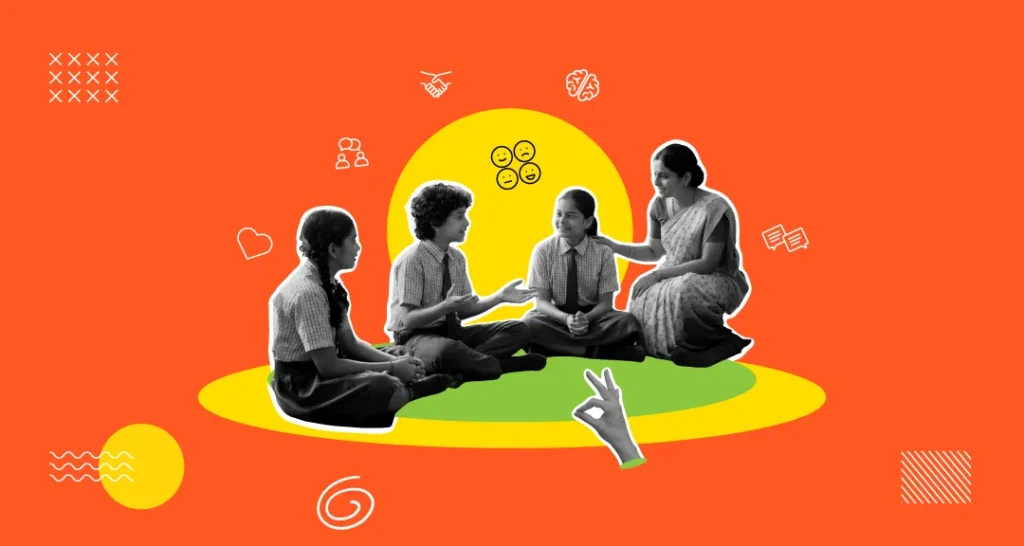
In January 2026, the Central Board of Secondary Education (CBSE) released a notification announcing Psycho-Social Counselling Services for students appearing in the Class X and Class XII examinations. The move formally recognises mental health as an important pillar of student success — not separate from academics, but deeply connected to it.
This policy direction reinforces what educators have long experienced in practice: Social Emotional Learning in schools is essential. (Details of the CBSE initiative are discussed later in this article.)
Classrooms are not simply academic spaces; they are emotional ecosystems.
If students feel stressed, unseen, or unsafe, even the most carefully designed lesson struggles to land. Numerous studies indicate that students who feel emotionally supported are more likely to engage, retain information, and perform well academically. Learning does not happen in isolation from emotions; rather, it depends on them. This is why SEL in classrooms becomes foundational to both emotional health and academic achievement, fostering classroom environments where students feel secure enough to participate and excel.
During a VOLT Learning webinar on Social Emotional Learning, educator Abha Arora unpacked what SEL looks like in everyday teaching. She emphasised that SEL is not extra work or a counselling add-on, but something that can be woven into existing classroom routines.
Every day, a teacher walks into class carrying two things: a candle and a mirror.
The candle represents knowledge.
The mirror represents the child’s inner world.
When a student arrives angry or disruptive, the teacher does not begin with the textbook. Instead, she begins with the mirror; only after the child feels emotionally seen does learning resume.
This rephrasing matters because what is often labelled as “misbehaviour” is frequently an unmet emotional need. Instruction cannot compete with a nervous system in distress.
What Is Social Emotional Learning (SEL)? A Teacher’s Definition
Social Emotional Learning is the process through which students develop the ability to:
- understand and manage emotions
- build empathy and social awareness
- form healthy relationships
- make responsible decisions
- manage challenges with steadfastness
SEL for teachers is not confined to primary grades, nor is it the responsibility of counsellors alone. It spans primary and secondary education, subjects, and age groups, supporting the creation of emotionally intelligent classrooms.
The Five SEL Competencies, Explained For Classrooms
1. Self-awareness: “Name it to tame it”
Many students struggle to label their feelings.
Effective SEL routines for classrooms include:
- emoji-based check-ins
- emotional vocabulary building
- short “how are you feeling today?” prompts
When students express emotions like, “I feel anxious before presentations,” support is possible.
2. Self-management: regulation, not suppression
Self-management means handling emotions during stress, conflict, or failure.
Common SEL strategies for teachers:
- breathing exercises
- silent pauses
- mindful transitions
- short movement breaks
The goal is not constant calmness, but healthy affective regulation.
3. Social awareness: empathy is a learned skill
Empathy develops through guided practice.
Classroom-based SEL activities for students include:
- perspective-taking discussions
- recognising emotions in peers
- thinking about how actions affect others
Empathy transforms classroom relationships when modelled and reinforced.
4. Relationship skills: teaching what may not be modelled
With changing household structures and busy routines, many students do not consistently observe healthy communication at home.
Schools play a key role in teaching:
- active listening
- respectful disagreement
- collaboration and teamwork
These skills are essential far beyond school years.
5. Responsible decision-making: learning through choice
Decision-making grows through experience, not control.
Classroom practices include:
- delivering structured choices
- thinking about outcomes
- discussing consequences without shame
This builds accountability and independence.
SEL And Academic Achievement: The Direct Connection
When students find themselves emotionally unsafe, learning shuts down.
An emotionally safe classroom enables:
- Sustained attention
- Attendance without fear
- Better memory and retention
- Joint problem-solving
Schools integrating SEL within daily routines consistently report:
- Fewer disciplinary incidents
- Improved classroom focus
- Stronger peer relationships
SEL protects academic time rather than detracting from it.
What An Emotionally Safe Classroom Looks Like
Teachers describe these classrooms using words like trust, belonging, and freedom to speak.
In practice, this includes:
- Respectful teacher-student relationships
- Predictable routines and clear expectations
- Mistakes treated as learning moments
- Active listening by adults
- Inclusive practices across language, ability, and background
- Calm down or reset spaces
- Zero tolerance for bullying
10 SEL Routines Teachers Can Start This Week
Low-prep, high-impact social-emotional learning activities:
- emoji-based feeling check-ins
- one-word mood scans
- five-minute morning meetings
- traffic-light emotional check-ins
- one-minute reflection journals
- mindful transitions between subjects
- calm-down corners
- co-created class agreements
- correct pronunciation of student names
- growth-mindset language (“not yet”)
These routines work across age groups and subjects.
Embedding SEL Within Subjects (Without Losing Time)
Mathematics
- Pause-and-breathe moments during difficulty
- Explaining strategies to build confidence
- Group problem-solving
- Reflection on emotional experience in the course of tasks
Science
- Discussing ethical and social impact
- Empathy through environmental topics
- Structured debates
- Teamwork during experiments
Language and Literacy
- Journaling for emotional consciousness
- Analysing character emotions
- Role-play for communication and conflict resolution
This shows how to implement SEL without adding periods.
Teacher SEL: Modelling Matters
Students learn more from what teachers do than what they say.
Teacher SEL includes:
- Naming emotions calmly
- Responding instead of reacting
- Modelling empathy
- Respectful correction
- Accountability
An emotionally regulated teacher creates an emotionally regulated classroom.
CBSE’s Psycho-Social Counselling Initiative: Details And Implications
Returning to the CBSE notification mentioned earlier:
The Board has launched free Psycho-Social Counselling Services from 6 January to 1 June 2026 for Classes X and XII students.
The initiative includes:
- a 24×7 toll-free IVRS helpline in Hindi and English
- tele-counselling support from trained counsellors, psychologists, principals, and special educators
- digital resources on stress management, emotional well-being, and study strategies
This policy move formally aligns national education systems with the goals of SEL in Indian schools, reinforcing that emotional health and academic success are inseparable and that SEL practices directly support academic goals.
A simple starting point
Choose one SEL practice to begin tomorrow:
- a traffic-light check-in
- a one-minute reflection
- a mindful pause
Consistency matters more than intensity. SEL grows through repetition — and classrooms grow safer, calmer, and more focused because of it.
Frequently Asked Questions:
1. What is Social Emotional Learning (SEL) in schools?
Social Emotional Learning (SEL) is how students learn to understand their emotions, manage them effectively, build empathy, form healthy relationships, and make responsible choices. In schools, SEL helps students feel safe, supported, and confident — creating the emotional foundation they need to learn, participate, and grow academically.
2. Why is SEL important for academic achievement?
Because students cannot learn well when they feel stressed, anxious, or unsafe. SEL helps students focus better, regulate emotions, build confidence, and stay engaged in class. When students feel emotionally supported, they are more likely to attend regularly, participate actively, and perform better in assessments.
3. Is Social Emotional Learning part of CBSE guidelines?
Yes. In January 2026, CBSE formally recognised the importance of student mental health by introducing Psycho-Social Counselling Services for Class X and XII students. This step aligns closely with SEL principles and reinforces the idea that emotional well-being and academic success are deeply connected.
4. How can teachers implement SEL in classrooms without extra periods?
SEL does not need separate periods or additional workload. Teachers can integrate it into everyday classroom routines — through short check-ins, reflection questions, group work, mindful pauses, and respectful discussions. Small, consistent practices woven into regular lessons make SEL both practical and effective.
5. What are the five core competencies of Social Emotional Learning?
The five core SEL competencies are self-awareness, self-management, social awareness, relationship skills, and responsible decision-making. Together, these skills help students understand their emotions, empathise with others, handle challenges calmly, build healthy relationships, and make thoughtful choices.
6. What are some simple SEL activities teachers can start immediately?
Teachers can begin with simple, low-prep practices such as emoji-based feeling check-ins, one-word mood sharing, short breathing pauses, calm-down corners, co-created class agreements, and growth-mindset language like “not yet.” These small steps can make a big difference in classroom climate.
7. How can SEL be integrated into subjects like Maths and Science?
In Maths, SEL can be supported through pause-and-breathe moments, collaborative problem-solving, and reflection on learning struggles. In Science, teachers can build SEL through teamwork during experiments, discussions on ethical and environmental issues, and structured group activities that promote empathy and cooperation.
8. How can schools start implementing SEL systematically?
Schools can start by supporting teachers through training, embedding SEL into daily routines, aligning classroom practices with SEL competencies, and prioritising teacher well-being. Beginning with small, consistent steps helps build a sustainable and school-wide culture of emotional safety and learning.
Share On: